
If your brand disappeared from generative search answers tomorrow, would you know?
For most marketing and communications teams, the honest answer is no, and that's a problem.
Today, nearly half of all online searches end without a single click. Bain & Company research indicates that approximately 70% of consumers are using generative search tools as part of their product research and purchase decision-making process. Tools like ChatGPT, Perplexity and Google's AI Overviews now synthesize answers for users directly, pulling from a curated set of sources they've determined to be credible and authoritative. Your brand might be seen, cited or completely passed over, and your traditional analytics won't lend you much insight.
The gap between what you're doing and what generative engines are surfacing is where brand visibility is being won and lost right now.
In this article, we'll cover:
- What brand visibility in generative search is and why it's become the new measure of brand authority
- How generative search is rewriting the rules of earned media and what that means for your strategy
- The earned media challenges brands are navigating in today's crowded, AI-filtered landscape
- A practical 5-step framework for optimizing your content so it shows up where it counts
What is brand visibility and why does it matter?
Brand visibility refers to how often, how accurately and how prominently your brand appears in generative search results, recommendations and summaries.
Instead of measuring whether your website ranks on page one of Google, brand visibility focuses on whether your brand becomes part of the answers that appear in front of your audience.
“So the goal isn't to be clicked anymore. It's to be cited. To be the source AI trusts when it speaks on your behalf,” says Stacy Stusynski, Chief Commercial Officer at Brandpoint. “And here's the part that catches brands off guard — it's not just about being mentioned. It's about being represented accurately. AI is speaking for your brand right now, whether you've invested in it or not.”
AI visibility is not just SEO with a new name
One of the most common misconceptions right now is that optimizing for generative search is simply a rebranding of search engine optimization. It isn't. Traditional SEO focuses on earning a position on a results page — you optimize keywords, build authority and aim to rank above competitors. The goal is to get found.
AI visibility changes that dynamic entirely. Instead of presenting users with a list of links, AI platforms synthesize information from multiple sources and generate a direct answer. In many cases, the user never sees a list of results at all. The goal shifts from ranking to being referenced — becoming the source AI reaches for when generating answers about your category, products or expertise.
For a deeper dive into what brand visibility means and the factors to consider that play an important role in AI-driven discovery, read the full article, What Is AI Visibility and Why Does It Matter for Brands?
How AI Is Rewriting the Rules of Earned Media
Earned media has always been one of the most valuable tools in a communicator's toolbox. A journalist independently chooses to cover your story, a publisher runs your perspective, an editor decides your expertise is worth sharing — all third-party validation that a brand can't manufacture on its own. That independence is what gives earned media its credibility.
But generative search evaluates content differently and that's changing how brands need to think about earned media entirely.
As Brandpoint CEO Lisa Jilek puts it: "In the AI era, the category of 'earned media' isn't determined solely by how content was placed. What matters most is where the content lives and whether AI systems view that source as authoritative, relevant and trustworthy."
That's a fundamental shift. AI systems aren't asking whether a placement was earned, paid or sponsored. They're looking at where the content lives, how credible the source is, how current the information is and whether the same signals are being reinforced across other trusted environments.
What signals are generative engines actually looking for?
When a generative engine builds an answer, it doesn't pull from a single source. It evaluates patterns across the web to determine what information appears credible and trustworthy. Most are looking for a consistent set of signals:
- Authority — Is this source recognized as knowledgeable on the topic?
- Consistency — Is the same message reinforced across multiple trusted environments?
- Recency — Is the information current?
- Credibility — Does the content come from reputable publishers or experts?
- Frequency — How often is this brand or perspective being discussed?
This is why the relationship between paid and earned media matters more than ever. Sponsored content published on credible third-party domains reinforces the same authority signals AI looks for — and when earned editorial coverage validates that footprint, AI models begin to see consensus. That consensus is what builds brand authority over time.
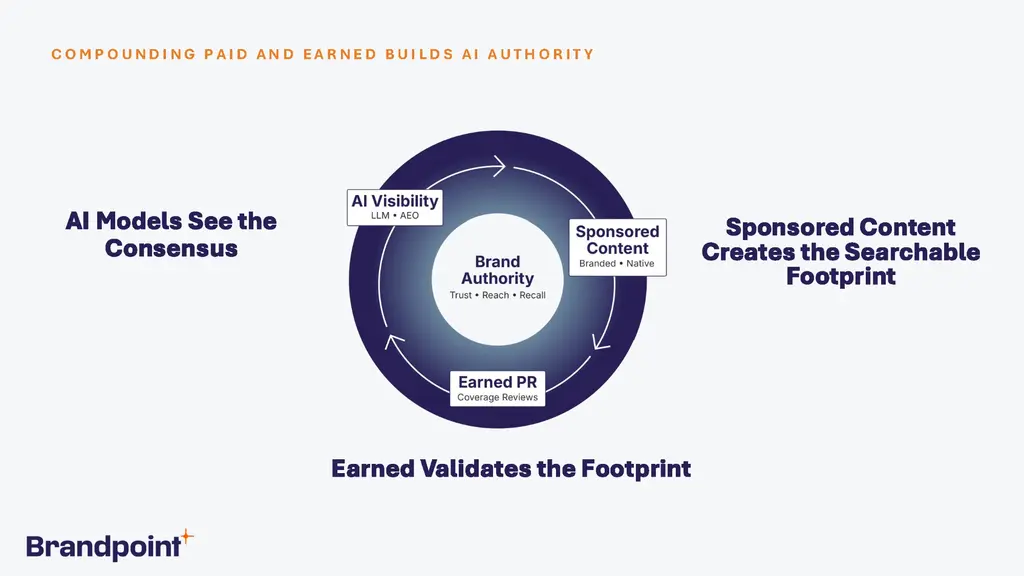
The goal isn't simply to show up in AI-generated answers. It's to be represented accurately when you do and to build the kind of consistent, credible presence that makes accurate representation inevitable.
To learn how AI is redefining earned media, read the full article, How AI Is Changing the Definition of Earned Media.
Earned Media Challenges and How Brands Are Adapting
Earned media is becoming harder to secure and harder to sustain. If your team has felt that pressure increasing, you're not imagining it.
While earned media may be more challenging to secure, it is also becoming more valuable.
As consumers increasingly turn to generative search answers, summaries and recommendations, AI systems are looking for signals that indicate credibility, authority and trustworthiness. Many of those signals come from the same places communicators have always focused on: trusted publishers, third-party validation, expert commentary and consistent visibility across credible sources.
AI systems are not asking whether a placement was earned, paid or syndicated. They are looking at where the content lives, whether the source is credible, how current the information is and whether the same ideas are reinforced across other trusted environments.
That means the goal has shifted from earning coverage to building a sustained presence. Brands winning in this environment stay visible consistently, reinforce key messages across trusted environments and treat earned media as an integrated part of a broader strategy — not a standalone tactic.
For more on the earned media landscape in 2026, read our article, How Brands Can Strengthen Visibility Despite Earned Media Challenges.
A 5-Step Framework for Optimizing Your Content for Brand Visibility
Understanding brand visibility and earned media's role in it is one thing. Putting it into practice is another. The good news is that the path forward isn't about overdoing everything; it's about making the content you already invest in work harder and smarter.
Visibility today is built through a combination of credibility, consistency and distribution across trusted environments. These five steps are how you get there.
Step 1: Create content that answers real questions
Start with intent. Define what you want your brand to be known for and what specific questions you want to show up for. Content built around a clear purpose stops being noise and starts becoming a genuine visibility signal for both audiences and AI.
Step 2: Write with clarity and structure
AI systems are designed to identify and summarize information quickly. Content that directly and clearly answers questions is far more likely to be surfaced in summaries and citations than content that buries its point. That means clear headlines and subheads, concise paragraphs, direct answers and structured formats like lists and FAQs. This isn't about dumbing content down, it's about making strong ideas easy for both people and AI to understand and repeat.
Step 3: Publish in credible environments
Where your content lives matters as much as what it says. Generative engines prioritize content from sources they recognize as authoritative — which means branded content placed in trusted third-party media environments carries significantly more weight than content that exists only on your own channels. A joint study conducted by Stacker and Scrunch found that content distributed through third-party news and publisher networks generated a 325% increase in AI citations.
Step 4: Make distribution part of the strategy from day one
One placement is rarely enough. AI systems and audiences alike look for consistent signals across multiple sources — the more your content appears across trusted environments, the stronger your visibility becomes. Distribution shouldn't be an afterthought after content is created. It should be planned from the start, with a clear picture of how content will be shared, repurposed and amplified over time. Visibility is built through repetition, not one-time reach.
Step 5: Build visibility through repeated, consistent expertise
The brands most likely to stay visible in AI-generated answers are the ones that show up consistently on their core topics. Instead of treating branded content as a one-time asset, treat it as part of a longer-term authority-building strategy. When your brand publishes regularly on the same priority topics across credible environments, AI systems begin to recognize it as a trusted source — and that recognition compounds over time.
Together, these five steps reflect a shift in how visibility works: it's no longer about a single strong piece of content or a single great placement. It's about building the kind of sustained, credible presence that audiences and AI systems learn to reach for.
The brands winning aren’t waiting
Building brand visibility requires more than one tactic, but the shift to AI-driven discovery hasn't replaced the fundamentals of a strong communications strategy. Brands that understand that connection, and act on it, are the ones that will show up when it counts.
Ready to see how it works in practice? Watch our free webinar, Does AI Love Your Brand?, to explore how brands are building authority, strengthening brand visibility and adapting to the future of discovery.
If your goal is to build stronger visibility, reinforce authority and create content that performs across modern discovery environments, Brandpoint can help. Contact us to learn more.